Saturday, March 31, 2018

March 31, 2018 Saturday

Bedtime Story 


Note D of Ada Lovelace - 3 to Note B - 1


We are continuing tonight with Note D of Ada Lovelace.

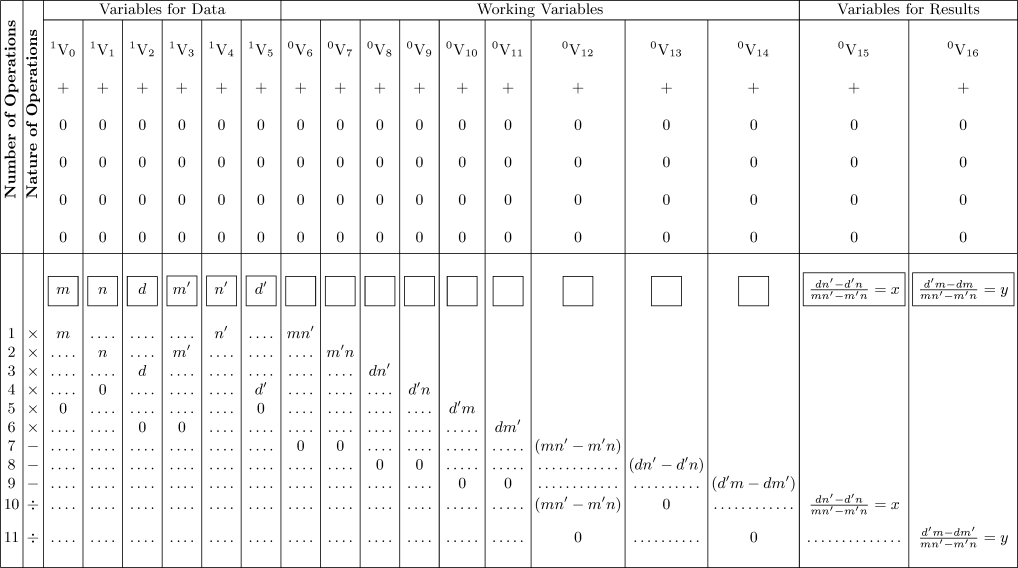
“Now the ordinary rule is, that the value returns to the Variable; unless it has been foreseen that no use for that value can recurs, in which case zero is substituted.

At the end of a calculation, therefore, every column ought as a general rule to be zero, excepting those for results.

Thus it will be seen by the diagram, that when m, the value on V0, is used for the second time by Operation 5, V0 becomes 0, since m is not needed again; that similarly when (mn’ – m’n), on V12, is used for the third time by Operation 11, V12 becomes zero, since (mn’ – m’n) is not needed again.

In order to provide for the one or the other of the courses above indicated, there are two varieties of the Supplying Variable-cards.

One of these varieties has provisions which cause the number given off from any Variable to return to that Variable after doing its duty in the mill.

The other variety has provisions which cause zero to be substituted on the Variable, for the number given off.

The two varieties are distinguished, when needful, by the respective appellations of the Retaining Supply-cards and the Zero Supply-cards.

We see that the primary office of both these varieties of cards is the same; they only differ in their secondary office.”

Now to understand the concept of office we will have to leave the Note D for a while and go to Note B.

I know that we are jumping Notes and that ideally should not be happening, but since here I expect little protest and whatever little may arise will most likely be ignored in the interest of greater understanding and flow of the story.

“Note B

This portion of the analytical Engine here alluded to (by Menabrea) is called the storehouse.

It contains an indefinite number of the columns of discs described by M. Menabrea.

The reader may picture to himself a pile of rather large draughtsmen (pieces of draughts game) heaped perpendicularly one above another to a considerable height, each counter having the digits from 0 to 9 inscribed on its edge at equal intervals; and if he then conceives that the counters do not actually lie one upon another so as to be in contact, but are fixed at small intervals of vertical distance on a common axis which passes perpendicularly through their centers, and around which each disc can revolve horizontally so that any required digit amongst those inscribed on its margin can be brought into view, he will have a good idea of one of these columns.

The lowest of the discs on any column belongs to the units, the next above to the tens, the next above this to the hundreds, and so on.

Thus if we wished to inscribe 1345 on a column of the engine, it would stand thus:

                     1

                     3

                     4

                     5  

Stay tuned to the voice of an average story storytelling chimpanzee or login at http://panarrans.blogspot.com
                              
Good night mon ami and my fellow cousin ape.


Advertisements

Another great educator and a teacher that I am aware of is Professor Subhashish Chattopadhyay in Bangalore, India.

While I narrate stories, Professor Subhashish an electronic engineer and a former professor at BARC, does and teaches real mathematics and physics.

He started the participation of Indian students at the International Physics Olympiad.

Do visit him here:


All his books can be downloaded for free through this link:


For edutainment and English education of your children, I recommend this large collection of Halloween Songs for Kids:


Friday, March 30, 2018

March 30, 2018 Friday

Bedtime Story 


Note D of Ada Lovelace - 2


We are continuing tonight with Note D of Ada Lovelace.

“In all calculations, the columns of Variables used may be divided into three classes:-

1st. Those on which the data are inscribed:

2ndly. Those intended to receive the final results:

3rdly. Those intended to receive such intermediate and temporary combinations of the primitive data as are not to be permanently retained, but are merely needed for working with, in order to attain the ultimate results.

Combinations of this kind might properly be called secondary data.

They are in fact so many successive stages towards the final result.

The columns which receive them are rightly named Working-Variables, for their office is in its nature purely subsidiary to other purposes.

They develop an intermediate and transient class of results, which unite the original data with the final results.

The Result-Variables sometimes partake of the nature of Working-Variables.

It frequently happens that a Variable destined to receive a final result is the recipient of one or more intermediate values successively, in the course of the processes.

Similarly, the Variables for data often become Working-Variables, or Result-Variables, or both in succession.

It so happens, however, that in the case of the present equations the three sets of offices remain throughout perfectly separate and independent.

It will be observed, that in the squares below the Working-Variables nothing is inscribed.

Any one of these Variables is in many cases destined to pass through various values successively during the performance of a calculation (although in these particular equations no instance of this occurs).

Consequently no one fixed symbol, or combination of symbols, should be considered as properly belonging to a merely Working-Variable; and as a general rule their squares are left blank.

Of course in this, as in all other cases where we mention a general rule, it is understood that many particular exceptions may be expedient.

In order that all the indications contained in the diagram may be completely understood, we shall now explain two or three points, not hitherto touched on.

When the value on any Variable is called into use, one of two consequences may be made to result.

Either the value may return to the Variable after it has been used, in which case it is ready for a second use if needed; or the Variable may be made zero.

(We are of course not considering a third case, of not unfrequent occurrence, in which the same Variable is destined to receive the result of the very operation which it has just supplied with a number.)”

Stay tuned to the voice of an average story storytelling chimpanzee or login at http://panarrans.blogspot.com
                              
Good night mon ami and my fellow cousin ape.


Advertisements

Another great educator and a teacher that I am aware of is Professor Subhashish Chattopadhyay in Bangalore, India.

While I narrate stories, Professor Subhashish an electronic engineer and a former professor at BARC, does and teaches real mathematics and physics.

He started the participation of Indian students at the International Physics Olympiad.

Do visit him here:


All his books can be downloaded for free through this link:


For edutainment and English education of your children, I recommend this large collection of Halloween Songs for Kids:


Thursday, March 29, 2018

March 29, 2018 Thursday

Bedtime Story 


Switching from Note G - 7 of Ada Lovelace to Note D - 1


We are continuing tonight with Note G of Ada Lovelace.

“On attentively considering (8.), we shall likewise perceive that we may derive from it the numerical value of every Number of Bernoulli in succession, from the very beginning, ad infinitum, by the following series of computations:-

1st Series - Let n = 1, and calculate (8.) for this value of n.

The result is B1.

2nd Series - Let n =2

Calculate (8.) for this value of n, substituting the value of B1 just obtained.

The result is B3.

3rd Series – Let n = 3

Calculate (8.) for this value of n, substituting the value of b3 just obtained.

The result is B5.

And so on, to any extent.

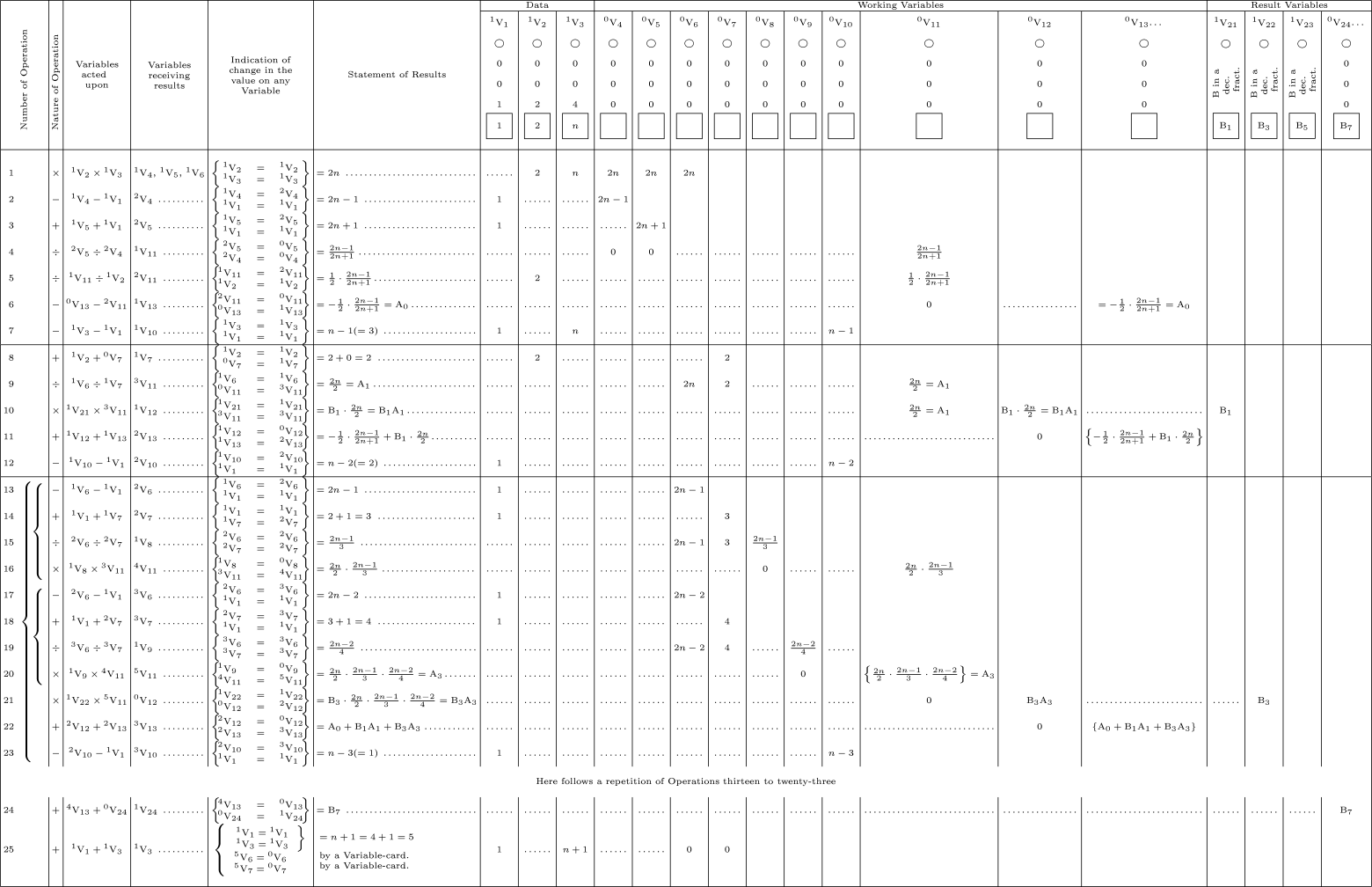
The diagram (to whose link Pan narrans gave before) represents the engine when just prepared for computing B2n-1 (in the case of n=4); while the table beneath them represents a complete simultaneous view of all the successive changes which these columns then severally pass through in order to perform the computation.”

To understand the complicated table, Ada Lovelace asks the readers to refer to Note D and hence we shall now shift to Note D before returning to Note G and continuing from here.

“                              Note D

We have represented the solution of these two equations below, with every detail, in a diagram similar to those used in Note B; but additional explanations are requisite, partly in order to make this more complicated case perfectly clear, and partly for the comprehension of certain indications and notations not used in the preceding diagrams.

Those who may wish to understand Note G completely, are recommended to pay particular attention to the contents of the present Note, or they will not otherwise comprehend the similar notation and indications when applied to a much more complicated case.


The link to the enlarged version of this table is given below:


Stay tuned to the voice of an average story storytelling chimpanzee or login at http://panarrans.blogspot.com
                              
Good night mon ami and my fellow cousin ape.


Advertisements

Another great educator and a teacher that I am aware of is Professor Subhashish Chattopadhyay in Bangalore, India.

While I narrate stories, Professor Subhashish an electronic engineer and a former professor at BARC, does and teaches real mathematics and physics.

He started the participation of Indian students at the International Physics Olympiad.

Do visit him here:


All his books can be downloaded for free through this link:


For edutainment and English education of your children, I recommend this large collection of Halloween Songs for Kids:


Wednesday, March 28, 2018

March 28, 2018 Wednesday

Bedtime Story 


Note G of Ada Lovelace - 6


We are continuing tonight with Note G of Ada Lovelace.

“If that distance be = d, then            


It is with the independent formula (8.) that we have to do.
        
Therefore it must be remembered that the conditions for the value of n are now modified, and that n is a perfectly arbitrary whole number.

This circumstance, combined with the fact (which we may easily perceive) that whatever n is, every term of (8.) after the (n+1)th is = 0, and that the (n+1)th term itself is always =\BB{2n-1}\cdot\frac{1}{1}=\BB{2n-1}, enables us to find the value (either numerical or algebraical) of any nth Number of Bernoulli B2n+1, in terms of all the preceding ones, if we but know the values of B1, B3…B2n-3  .    

We append to this Note a Diagram and a Table, containing the details of the computation for B7 (B1, B3, B5 being supposed given).

Clip from diagram of computation of the Numbers of Bernoulli
The diagram of the computation of the Numbers of Bernoulli is very large and intricate, and cannot be displayed as an in-line image in this document. If reduced to fit on a typical computer screen, the text in the diagram is illegible. The diagram is available at two different resolutions; the following links will display the version you select in a separate browser window (assuming your browser provides this feature), which will permit you to refer to the diagram, scrolling as necessary, while reading the following text. If you have a PostScript printer, you can download a ready-to-printPostScript file (in a ZIPped archive), which prints the diagram on a single page of paper.

View diagram in new browser window: 


The diagram of the computation of the Numbers of Bernoulli is very large and intricate, and cannot be displayed as an in-line image but would be better visualized and accessed through this link given below:


Stay tuned to the voice of an average story storytelling chimpanzee or login at http://panarrans.blogspot.com
                              
Good night mon ami and my fellow cousin ape.


Advertisements

Another great educator and a teacher that I am aware of is Professor Subhashish Chattopadhyay in Bangalore, India.

While I narrate stories, Professor Subhashish an electronic engineer and a former professor at BARC, does and teaches real mathematics and physics.

He started the participation of Indian students at the International Physics Olympiad.

Do visit him here:


All his books can be downloaded for free through this link:


For edutainment and English education of your children, I recommend this large collection of Halloween Songs for Kids:

Tuesday, March 27, 2018

March 27, 2018 Tuesday

Bedtime Story 


Note G of Ada Lovelace - 5


We are continuing tonight with Note G of Ada Lovelace.

“As however our object is not simplicity or facilitation of computation, but the illustration of the powers of the engine, we prefer selecting a formula below, marked (8).

This is derived in the following manner: –

If in the equation

\frac{x}{\epsilon^x-1}=1-\frac{x}{2}+\BB{1}\frac{x^2}{2}+\BB{3}\frac{x^4}{2\cdot 3 \cdot 4} + \BB{5}\frac{x^6}{2\cdot 3 \cdot 4 \cdot 5 \cdot 6}+\cdots 

Numbered as (4.)

(in which B1, B3… etc are the Numbers of Bernoulli), we expand the denominator of the first side in powers of x, and then divide both numerator and denominator by x, we shall derive

1=\left(1-\frac{x}{2}+\BB{1}\frac{x^2}{2}+\BB{3}\frac{x^4}{2\cdot 3\cdot 4}+\cdots\right)\left(1+\frac{x}{2}+\frac{x^2}{2\cdot 3}+\frac{x^3}{2\cdot 3\cdot 4}+\cdots\right) 

Numbered as (5.)

If this latter multiplication be actually performed, we shall have a series of the general form

1 + D1x + D2x2 + D3x3 + …                             (6.)

In which we see, first, that all the coefficients of the powers of x are severally equal to zero; and secondly, that the general form for D2n, the coefficient  of the 2n+1th term (that is of x2n and even powers of x), is the following:-


Numbered as (7.)

Multiplying every term by (2.3…2n) we have


Numbered as (8.)

Which it may be convenient to write under the general form:-

0 = A0 + A1B1 + A3B3 + A5B5 +…+ B2n-1                    (9.)

A1, A3 etc being those functions of n which respectively belong to B1, B3 etc.

We might have derived a form nearly similar to (8.), from D2n-1 the coefficient of any of power of x in (6.), but the general form is a little different for the coefficients of the odd power, and not quite so convenient.

On examining (7.) and (8.), we perceive that, when these formulae are isolated from (6.), whence they are derived, and considered in themselves separately and independently, n may be any whole number whatever; although when (7.) occurs as one of the D’s in (6.), it is obvious that n is then not arbitrary, but is always a certain function of the distance of that D from the beginning.”

Stay tuned to the voice of an average story storytelling chimpanzee or login at http://panarrans.blogspot.com
                              
Good night mon ami and my fellow cousin ape.


Advertisements

Another great educator and a teacher that I am aware of is Professor Subhashish Chattopadhyay in Bangalore, India.

While I narrate stories, Professor Subhashish an electronic engineer and a former professor at BARC, does and teaches real mathematics and physics.

He started the participation of Indian students at the International Physics Olympiad.

Do visit him here:


All his books can be downloaded for free through this link:


For edutainment and English education of your children, I recommend this large collection of Halloween Songs for Kids:


Monday, March 26, 2018

March 26, 2018 Monday

Bedtime Story 


Re-initiating Note G of Ada Lovelace - 4

 
I shall renew my quotation of Note G of Lovelace which is both technical and mathematical but I owe it to sapiens apes to republish the first ever algorithm.

This part also reflects the depth of knowledge of Ada Lovelace both in mathematics as well as the proposed analytical engine of Babbage.

The notes of Ada Lovelace do not make for an easy reading as not only it is highly mathematical but it is mathematical algorithm applied to a universal Turing machine that to this very day has never got itself invented.

This is not to say that it will never be constructed for as I write this bedtime story a movement is gathering steam around one John Graham-Cumming, a British computer programmer and writer who in October 2010 initiated a program of reconstruction of Charles Babbage’s Analytical Engine. 

The design that he is hoping to recreate goes by the name of Plan 28 which would involve three crucial steps:

(a) Deciphering of the writings and illustrations of Babbage

(b) Building a 3 D simulation of the engine and

(c) Construction of the actual mechanical steam-powered universal computing machine

Just as an addition, John Graham-Cumming also happens to be the guy who initiated the successful petition to the British government seeking an apology for its persecution of Alan Turing.

I promise that after quoting the various Notes of Ada Lovelace starting from Note G and then going along as the need warrants, I will describe the essence of all her notes in a much more simpler, modern and non-mathematical English.

Till then please bear with me.

Re-initiating the Note G:

“The simplest manner of computing these numbers (Bernoulli’s) would be from the direct expansion of

\frac{x}{\epsilon^x-1}=\frac{1}{1+\frac{x}{2}+\frac{x^2}{2\cdot 3}+\frac{x^3}{2\cdot 3\cdot 4}+{\rm \ETC}}

                (1.)

Which is in fact a particular case of the development of

\frac{a+bx+cx^2+\RMETC}{a'+b'x+c'x^2+\RMETC} 

mentioned in Note E

Or again, we might compute them from the well-known form

{\rm B}_{2n-1}=2\cdot\frac{1\cdot 2\cdot 3\ldots 2n}{(2\pi )^{2n}}\cdot\left\{1+\frac{1}{2^{2n}}+\frac{1}{3^{2n}}+\cdots\right\} 
      (2.)

Or from the form

 
  (3.)

Or from many others

Stay tuned to the voice of an average story storytelling chimpanzee or login at http://panarrans.blogspot.com
                              
Good night mon ami and my fellow cousin ape.


Advertisements

Another great educator and a teacher that I am aware of is Professor Subhashish Chattopadhyay in Bangalore, India.

While I narrate stories, Professor Subhashish an electronic engineer and a former professor at BARC, does and teaches real mathematics and physics.

He started the participation of Indian students at the International Physics Olympiad.

Do visit him here:


All his books can be downloaded for free through this link:


For edutainment and English education of your children, I recommend this large collection of Halloween Songs for Kids:


Sunday, March 25, 2018


March 25, 2018 Sunday

Bedtime Story 


The First Twenty Numbers of Bernoulli 


Bernoulli numbers are depicted as Bn with the first Bernoulli number B0 being equal to 1 and the second Bernoulli number B1 being 1/2.

For all odd n other than 1, Bn = 0.

For all even n, Bn is negative if divisible by 4 otherwise they are positive.

So the first twenty Bn are as follows:

B0 = 1

B1 = 1/2

B2 = 1/6

B3 = 0

B4 = -1/30

B5 = 0

B6 = 1/42

B7 = 0

B8 = -1/30

B9 = 0

B10 = 5/66

B11 = 0

B12 = -691/2730

B13 = 0

B14 = 7/6

B15 = 0

B16 = -3617/510

B17 = 0

B18 = 43867/798

B19 = 0

B20 = -174611/330

Now how do we get the further Bernoulli numbers?

This is exactly the point when we need to return to Ada Lovelace and her Note G in her translation of the treatise of Luigi Menabrea.

It was on the night of February 16, 2018 Friday that we had digressed from Note G of Ada Lovelace – Part 3 to understand the story behind the Numbers of Bernoulli.

For it is here that this brilliant lady describes the algorithm for generating Bernoulli’s numbers using the engine of Charles Babbage.

This gives Bernoulli numbers the honor of being the subject of the first complex computer program ever to be published. 

In the nights to come, we shall return to the Note G of Ada Lovelace which I must warn with all sincerity will not make for an easy reading; yet I promise to clarify it in much simpler later language in future.

Stay tuned to the voice of an average story storytelling chimpanzee or login at http://panarrans.blogspot.com
                              
Good night mon ami and my fellow cousin ape.


Advertisements

Another great educator and a teacher that I am aware of is Professor Subhashish Chattopadhyay in Bangalore, India.

While I narrate stories, Professor Subhashish an electronic engineer and a former professor at BARC, does and teaches real mathematics and physics.

He started the participation of Indian students at the International Physics Olympiad.

Do visit him here:


All his books can be downloaded for free through this link:


For edutainment and English education of your children, I recommend this large collection of Halloween Songs for Kids: