March 01, 2018 Thursday
Bedtime Story
Brachistochrone Problem is Related to Light
That object which covers any distance in
shortest time, and thereby deploys brachistochrone principle naturally, is
light.
The principle that explains the path that
light takes is the Fermat’s principle which in turn leads to Snell’s law.
Most of us would recall having been taught
Snell’s Law in the very first chapter on optics in physics; It is generally
true that we remember having been taught something rather than remembering what
exactly it was that we were taught.
Yet Fermat’s principle would sound alien to
many of us in spite of familiarity with the name of this seventeenth century
French polymath.
It may be so because we most of us are
largely monopolized by English education who never had great feelings for anything
to do with Frenchmen.
Just as additional information, Snell’s law
is not named after some Englishman named John Snell but after a Dutch
astronomer Willebrord Snellius who lived between 1580 and 1626, died at a young
age of 46.
Just to show how unfair both history and
life is (Harari bluntly states that ‘there is no justice in history’), it was
not Snellius who had first accurately described this behavior of light but Ibn
Sahl, a Muslim Persian mathematician and physicist of the Islamic Golden Age.
Ibn Sahl in his treatise “On Burning Mirror
and Lenses” in 984 AD not only accurately described this law of light but used
it to describe construction of lenses that would refract light without unwanted
geometric aberrations.
Fermat’s principle is also known as the
principle of least time and it states that the path taken between two points by
a ray of light is that path that can be traversed in the least of time.
You must note that this principle was
stated by Pierre de Fermat in a letter to la Chambre on Jan 1, 1662 not too far
away from the time when the brachistochrone problem was proposed.
Fermat’s principle is in turn derived from
Huygens-Fresnel Principle which explains the movement of light as a wave front.
Fermat’s principle when elaborated gives
rise to Snell’s’ Law which relates the sines of the angle of incidence to that
of the refraction with the phase velocities.
Now Johann Bernoulli utilized exactly this
principle to come to a solution for his own brachistochrone problem which is
now called an indirect method.
On applying the mathematics of light to his
falling point from A to B, he came to the solution that the fastest route would
be a cycloid.
Cycloid is a curve that that is traced out
by a point on the rim of a circular wheel as the wheel rolls along a circular
line without slipping.
A cycloid also satisfies the differential
equation:
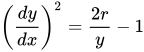
Where the horizontal base is given by the
line y = 0 and the circle has the radius r.
Stay tuned to the voice of an average story storytelling
chimpanzee or login at http://panarrans.blogspot.com
Good night mon ami and my fellow cousin ape.
Advertisements
Another great educator and a teacher that I am aware of is
Professor Subhashish Chattopadhyay in Bangalore, India.
While I narrate stories, Professor Subhashish an electronic
engineer and a former professor at BARC, does and teaches real mathematics and
physics.
He started the participation of Indian students at the
International Physics Olympiad.
Do visit him here:
All his books can be downloaded for free through this link:
For edutainment and English education of your children, I
recommend this large collection of Halloween Songs for Kids:

No comments:
Post a Comment