Monday, April 30, 2018

April 30, 2018 Monday

Bedtime Story 


Note D of Ada Lovelace - Part 5 


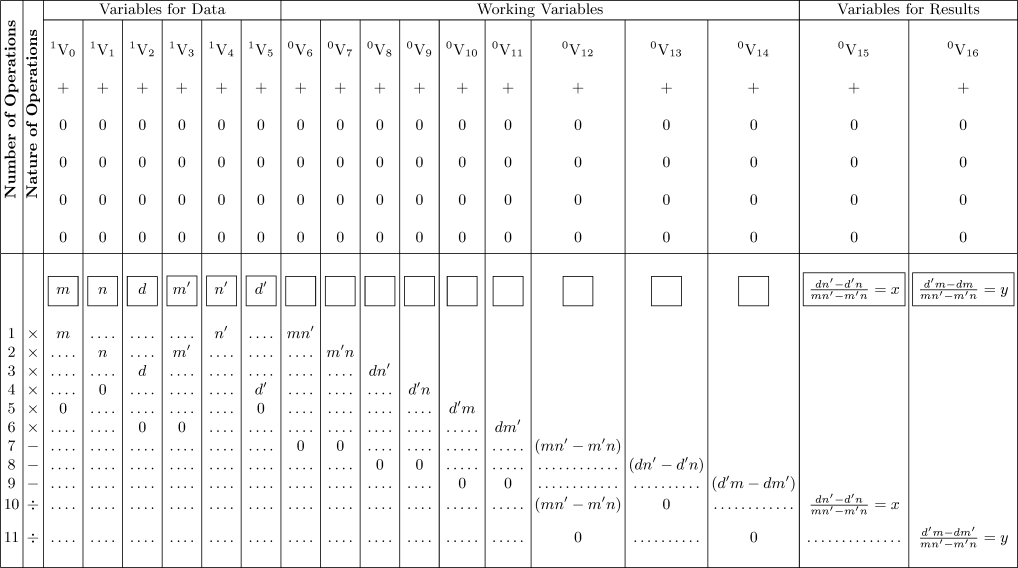
Tonight we shall be continuing with the Note D of Ada Lovelace wherein she is discussing the two flowchart diagrams that I printed out for you last night.

What she is saying that though both are analogous and both reflect each and every step that the engine would take to perform that mathematical operation, each one has certain and disadvantage, but together they are whole.

She here also describes the meaning of upper (to the left) and lower (to the right) indices in the Vs of Menabrea.

Understanding this notation is critical in comprehension of the flowchart tables.
 
“But it was fortunately inconvenient to print them in this desirable form.

The diagram is, in the main, merely another manner of indicating the various relations denoted in M. Menabrea’s table.

Each mode has some advantages and some disadvantages.

Combined, they form a complete and accurate method of registering every step and sequence in all calculations performed by the engine.

No notice has yet been taken of the upper indices which are added to the left of each V in the diagram; an addition which we have also taken the liberty of making to the V’s in M.

M. Menabrea’s table 3 and 4, since it does not alter anything therein represented by him, but merely adds something to the previous indications of those tables.

The lower indices are obviously indices of locality only, and are wholly independent of the operations performed or of the results obtained, their value continuing unchanged during the performance of calculations.

The upper indices, however, are of a different nature.

Their office is to indicate any alteration in the value which a Variable represents; and they are of course liable to changes during the processes of a calculation.

Whenever a Variable has only zeros upon it, it is called 0V; the moment a value appears on it (whether that value be placed there arbitrarily, or appears in the natural course of a calculation), it becomes 1V.

If this value gives place to another value, the Variable becomes 2V, and so forth.   

Whenever a value again gives place to zero, the Variable again becomes 0V, even if it have been nV the moment before.

If a value than again be substituted, the Variable becomes n+1V (as it would have done if it had not passed through the intermediate 0V; and so on. 
  
Just before any calculation is commenced, and after the data have been given, and everything adjusted and prepared for setting the mechanism in action, the upper indices of the Variables for data are all unity, and those for the Working and Result-variables are all zero.

In this state the diagram represents them.”

(To understand this last statement you will have to keep referring to the flowchart Table of Menabrea and watch closely how the upper left-handed indices are changing before and after the operations In the Variables for data, Working-Variables and Result-Variables).

Stay tuned to the voice of an average story storytelling chimpanzee or login at http://panarrans.blogspot.com
                              
Good night mon ami and my fellow cousin ape.


Advertisements

Another great educator and a teacher that I am aware of is Professor Subhashish Chattopadhyay in Bangalore, India.

While I narrate stories, Professor Subhashish an electronic engineer and a former professor at BARC, does and teaches real mathematics and physics.

He started the participation of Indian students at the International Physics Olympiad.

Do visit him here:


All his books can be downloaded for free through this link:


For edutainment and English education of your children, I recommend this large collection of Halloween Songs for Kids:


Sunday, April 29, 2018


April 29, 2018 Sunday

Bedtime Story 


Flowchart of Menabrea and that of Ada Lovelace for Solving Two Linear Equations with Two Variables


Tonight we shall be continuing with the Note D of Ada Lovelace wherein she is describing how the engine would go about solving two linear equations with two unknown variables x and y.

Last night, she had wished that we place her diagram next to the table of Menabrea side by side, so as to compare with it each line and thus each operation that the engine would follow.   

So following her wish, I am going to repost that table of Menabrea along with the table of Ada Lovelace as she is suggesting to us.

In it he particularly tried to explain how the Variable cards would interact with the vertical columns of discs; cards would be ordering what operations to perform and the vertical columns actually performing them.


The above two are the tables of Menabrea.

Now at bottom is the table of Lovelace.


Stay tuned to the voice of an average story storytelling chimpanzee or login at http://panarrans.blogspot.com
                              
Good night mon ami and my fellow cousin ape.


Advertisements

Another great educator and a teacher that I am aware of is Professor Subhashish Chattopadhyay in Bangalore, India.

While I narrate stories, Professor Subhashish an electronic engineer and a former professor at BARC, does and teaches real mathematics and physics.

He started the participation of Indian students at the International Physics Olympiad.

Do visit him here:


All his books can be downloaded for free through this link:


For edutainment and English education of your children, I recommend this large collection of Halloween Songs for Kids:


Saturday, April 28, 2018

April 28, 2018 Saturday

Bedtime Story 


Note D of Ada Lovelace - Part 4


Last night though I did not point it out then, was the end of Note B of Lady Ada which was frankly speaking wasn’t really mathematical though it was laced with lots of numbers and sketches that gave an appearance of mathematics.

In it, we were very broadly introduced to the analytical functioning of the engine; by analytical she means how the programs encoded in the different types of punching cards would interact with the vertical columns of discs and carry our operations of mathematical functions.

She restricted herself totally to the analysis of the engine and not to the mechanics of it, not explaining exactly how these various elements would be set to enable the engine for what it was meant to be.

This terminates the Note B of Ada Lovelace and again like Note A is rather easy to grasp if you care to take just a little bit of intellectual effort.

Note C was covered much earlier and it had absolutely nothing to do with mathematics; as a matter-of-fact, it was largely historical describing the association of the punched with weaving loom industry.

We had left Note D on the night of March 31, 2018 when Lovelace was talking about the working of the Variable-cards and then introduced the idea of primary office and the secondary office.

It is in the Note D wherein she takes the specific mathematical example used by Menabrea, that is, two equations of the first degree with two variables and arrive to the solutions of x and y.

Just to recall, let me list out those two equations and their solutions:

                              mx + ny = d

                             m’x + n’y = d’

We deduce  x=\frac{dn'-d'n}{n'm-nm'}        or x = (dn’-d’n)/(n’m-nm’)

And y for an analogous expression

Tonight we shall return to Note D from where we had left it for Note B on March 31, 2018 and in case you need to recollect what was stated in Note D, you simply have to seek the bedtime story of this particular night and read it through.

“Every Variable thus has belonging to it one class of Receiving Variable-cards and two classes of Supplying Variable-cards.

It is plain however that only the one or the other of these two latter classes can be used by any one Variable for one operation; never both simultaneously, their respective functions being mutually incompatible.

It should be understood that the Variable-cards are not placed in immediate contiguity with the columns.

Each card is connected by means of wires with the column it is intended to act upon.

Our diagram ought in reality to be placed side by side with M. Menabrea’s corresponding table, so as to be compared with it, line for line belonging to each operation.”

Stay tuned to the voice of an average story storytelling chimpanzee or login at http://panarrans.blogspot.com
                              
Good night mon ami and my fellow cousin ape.


Advertisements

Another great educator and a teacher that I am aware of is Professor Subhashish Chattopadhyay in Bangalore, India.

While I narrate stories, Professor Subhashish an electronic engineer and a former professor at BARC, does and teaches real mathematics and physics.

He started the participation of Indian students at the International Physics Olympiad.

Do visit him here:


All his books can be downloaded for free through this link:


For edutainment and English education of your children, I recommend this large collection of Halloween Songs for Kids:


Friday, April 27, 2018

April 27, 2018 Friday

Bedtime Story 


Note B of Ada Lovelace - Part 7


Tonight we shall continue with the Note B of Ada Lovelace which we shall pick up from the sketch of Lovelace that represented 9 Variable-columns of the mill that is handling not one but three functions with 6 variables, namely axn, bpy and then axn/bpy and the six variables being a, x, n, b, p and y.

The point she is making is that with multiple columns of vertical discs, multiple functions can be carried out by the machine as long as these columns get the right feed of orders from the Operation-Cards and appropriate values of variables via Variable-cards, though of course, she is evasive of the mechanical means of carrying these out out which perhaps she had left it to Charles Babbage to work it all out and maybe he had.  

“We may now desire to combine together these two results, in any manner we please; in which case it would only be necessary to have an additional card or cards, which would order the requisite operations to be performed with the numbers on the two result-columns V4 and V8, and the result of these further operations to appear on a new column, V9.

Say that we wish to divide axn by bpy.

The numerical value of this division would then appear on the column V9, beneath which we have inscribed axn/bpy.

The whole series of operations from the beginning would be as follows (n being = 7):

              {7 (x), 2 (x), }, or {9(x), }

This example is introduced merely to show that we may, if we please, retain separately and permanently any intermediate results (like axn, bpy) which occur in the course of processes having an ulterior and more complicated result as their chief and final object (like axn/bpy).

Any group of columns may be considered as representing a general function, until a special one has been implicitly impressed upon them through the introduction into the engine of the Operation and Variable-cards made out for a particular function.

This, in the preceding example, V1, V2, V3, V5, V6, V7 represent the general function (a, n, b, p, x, y) until the function axn/bpy has been determined on, and implicitly expressed by the placing of the right cards in the engine.

The actual working of the mechanism, as regulated by these cards, then explicitly develops the value of the function.

The inscription of a function under the brackets, and in the square under the result-column, in no way influences the processes or the results, and is merely a memorandum for the observer, to remind him of what is going on.

It is the Operation and the Variable-cards only which in reality determine the function.

Indeed it should be distinctly kept in mind, that the inscriptions without any of the squares are quite independent of the mechanism or workings of the engine, and are nothing but arbitrary memorandums placed there at pleasure to assist the spectator.

The further we analyze the manner in which such an engine performs its processes and attains its results, the more we perceive how distinctly it places in a true and just light the mutual relations and connection of the various steps of mathematical analysis; how clearly it separates those things which are in reality distinct and independent, and unites those which are mutually dependent.”

Stay tuned to the voice of an average story storytelling chimpanzee or login at http://panarrans.blogspot.com
                              
Good night mon ami and my fellow cousin ape.


Advertisements

Another great educator and a teacher that I am aware of is Professor Subhashish Chattopadhyay in Bangalore, India.

While I narrate stories, Professor Subhashish an electronic engineer and a former professor at BARC, does and teaches real mathematics and physics.

He started the participation of Indian students at the International Physics Olympiad.

Do visit him here:


All his books can be downloaded for free through this link:


For edutainment and English education of your children, I recommend this large collection of Halloween Songs for Kids:


Thursday, April 26, 2018

April 26, 2018 Thursday

Bedtime Story 


Note B of Ada Lovelace - Part 6


Tonight we shall continue with the Note B of Ada Lovelace wherein she is describing how the Operation-cards and Variable-cards will be interacting with the vertical columns of discs to operate on a mathematical function.

Here she is also describing how these vertical columns can act as temporary storage of working data, something that in today’s computers is performed by dynamic random-access memory integrated circuit using micro capacitors that can either be charged or discharged.

“There are two varieties of the Supplying Variable-cards, respectively adapted for fulfilling two distinct subsidiary purposes: but as these modifications do not bear upon the present subject, we shall notice them in another place.

In the above case of axn, the Operation-cards merely order seven multiplications, that is, they order the mill to be in the multiplying state seven successive times (without any reference to the particular columns whose numbers are to be acted upon).

The proper Distributive Variable-cards step in at each successive multiplication, and cause the distributions requisite for the particular case.

For xan               the operations would be              34 (x)

For a . n. x         the operations would be   (x, x) or 2 (x)

For (a/n).x         the operations would be                ( , x) 

For a + n + x     the operations would be    (+, +) or 2(+)  
 
The engine might be made to calculate all these in succession.

Having complete axn, the function xan might be written under the brackets instead of axn, and a new calculation commenced (the appropriate Operation and Variable-cards for the new function of course coming into play).

The results would then appear on V5.

So on for any number of different functions of the quantities a, n, x.

Each result might either permanently remain on its column during the succeeding calculations, so that when all the functions had been computed, their values would simultaneously exist on V4, V5, V6 etc; or each result might (after being printed off, or used in any specified manner) be effaced, to make way for its successor.

The square under V4 ought, for the latter arrangement, to have the functions axn, xan, anx, etc and successively inscribed in it.

Let us now suppose that we have two expressions whose values have been computed by the engine independently of each other (each having its own group of columns for data and results).

Let them be axn, and bpy.

They would the stand as follows on the columns:-


Stay tuned to the voice of an average story storytelling chimpanzee or login at http://panarrans.blogspot.com
                              
Good night mon ami and my fellow cousin ape.


Advertisements

Another great educator and a teacher that I am aware of is Professor Subhashish Chattopadhyay in Bangalore, India.

While I narrate stories, Professor Subhashish an electronic engineer and a former professor at BARC, does and teaches real mathematics and physics.

He started the participation of Indian students at the International Physics Olympiad.

Do visit him here:


All his books can be downloaded for free through this link:


For edutainment and English education of your children, I recommend this large collection of Halloween Songs for Kids:


Wednesday, April 25, 2018

April 25, 2018 Wednesday

Bedtime story 


Note B of Ada Lovelace - Part 5


Tonight we shall continue with the Note B of Ada Lovelace wherein she is giving attention to the mill and using the word “state” with reference to the mill which would later, after some 90 odd years in 1936, was to be used by Alan Turing in his seminal paper which I hope to cover some night in my bedtime stories.

Not only did both the computing giants used the word “state”, but they used this word to describe the computing process of a universal computing machine with an uncannily similar intent though of course, as mathematics and computer science grew and developed, this term gathered greater and greater complexity with immensely intricate mathematics backing it.

She is also describing here different types of punched cards that would enable the engine to carry out the entire chain of commands for performing a mathematical operation.  

“And here again is the illustration of the remarks made in the preceding Note (Note A) on the independent manner in which the engine directs its operations.

In determining the value of axn, the operations are homogenous, but are distributed amongst different subjects of operation, at successive stages of the computation.

It is by means of certain punched cards, belonging to the Variables themselves, that the actions of the operations is so distributed as to suit each particular function.

The Operation-cards merely determine the succession of operations in a general manner.

They in fact throw all that portion of the mechanism included in the mill into a series of different states, which we may call the adding state, or the multiplying state etc., respectively.

In each of these states the mechanism is ready to act in a way peculiar to that state, on any pair of numbers which may be permitted to come within its sphere of action.

Only one of these operating states of the mill can exist at a time; and the nature of the mechanism is also such that only one pair of numbers can be received and acted on at a time.

Now, in order to secure that the mill shall receive a constant supply of the proper pairs of numbers in succession, and that it shall also rightly locate the result of an operation performed upon any pair, each Variable has cards of its own belonging to it.

It has, first, a class of cards whose business it is to allow the number on the Variable to pass into the mill, there to be operated upon.

These cards may be called the Supplying-cards.

They furnish the mill with its proper food.

Each variable has, secondly, another class of cards, whose office it is to allow the Variable to receive a number from the mill.

These cards may be called the Receiving-cards.

They regulate the location of results, whether temporary or ultimate results.

The Variable-cards in general (including both the preceding classes) might, it appears to us, be even more appropriately designated the Distributive-cards, since it is through their means that the action of the operations, and the results of this action, are rightly distributed.”

Stay tuned to the voice of an average story storytelling chimpanzee or login at http://panarrans.blogspot.com
                              
Good night mon ami and my fellow cousin ape.


Advertisements

Another great educator and a teacher that I am aware of is Professor Subhashish Chattopadhyay in Bangalore, India.

While I narrate stories, Professor Subhashish an electronic engineer and a former professor at BARC, does and teaches real mathematics and physics.

He started the participation of Indian students at the International Physics Olympiad.

Do visit him here:


All his books can be downloaded for free through this link:


For edutainment and English education of your children, I recommend this large collection of Halloween Songs for Kids:


Tuesday, April 24, 2018

April 24, 2018 Tuesday

Bedtime Story 


Note B of Ada Lovelace - Part 4


Tonight we shall continue with the Note B of Ada Lovelace wherein she is describing how the engine would perform or carry out calculation with a specific function axn, with the values of the three variables a, n and x having been defined last night.

The instruction to the machine will be programmed much earlier by human apes in the punched cards which in turn will command the vertical columns how to move and rotate in order for the function to be worked out by the engine.

She, of course, does not go into the intricate mechanical details of it, for the engine then (and even today) was only at its conceptual stage.    

“We may now combine these symbols in a variety of ways, so as to form any required function or functions of them, and we may then inscribe each such functions below brackets, every bracket uniting together these quantities (and those only) which enter into the function inscribed below it.

We must also, when we have decided on the particular function whose numerical value we desire to calculate, assign another column to the right-hand for receiving the results, and must inscribe the function in the square below this column.

In the above instance we might have any one of the following functions:-

axn, xan, a . n . x, (a/n)x, a + n + x, etc.

Let us select the first.

It would stand as follows, previous to calculation:-


The data being given, we must now put into the engine the cards proper for directing the operations in the case of the particular function chosen.        
 
These operations would in this instance be –

First, six multiplication in order to get xn (= 987 for the above particular data)

Secondly, one multiplication in order then to get a.xn
(= 5.987)         
             
In all, seven multiplications to complete the whole process.

We may thus represent them:-

(x, x, x, x, x, x, x), or 7(x)

The multiplications would, however, at successive stages in the solution of the problem, operate on pairs of numbers, derived from different columns.

In other words, the same operation would be performed on different subjects of operation.”

Stay tuned to the voice of an average story storytelling chimpanzee or login at http://panarrans.blogspot.com
                              
Good night mon ami and my fellow cousin ape.


Advertisements

Another great educator and a teacher that I am aware of is Professor Subhashish Chattopadhyay in Bangalore, India.

While I narrate stories, Professor Subhashish an electronic engineer and a former professor at BARC, does and teaches real mathematics and physics.

He started the participation of Indian students at the International Physics Olympiad.

Do visit him here:


All his books can be downloaded for free through this link:


For edutainment and English education of your children, I recommend this large collection of Halloween Songs for Kids:


Monday, April 23, 2018

April 23, 2018 Monday

Bedtime Story 


Note B of Ada Lovelace - Part 3
       

Tonight it’s time to return back to Note B from where we had left it in the night of April 01, 2018 and proceed to Part 3 of the note B.

Note B will not be a breeze as was A because Note B is the description of the storehouse of the engine, which in today’s parlance is called memory.

To briefly recap, the storehouse would be series of columns of discs heaped one over the other to “a considerable height” with each disc numbered 0 to 9 equidistantly at its circumference.

The Difference Engine would have seven of these columns but the Analytical Engine would have “many more of these columns”. 

These columns of numbered discs she labels as Variable columns or sometimes simply as Variables with a capital “V” which she clarifies has nothing to do with the variables and constants that are used in mathematics.

Each column on top will have a empty circle that can be assigned either a ‘+’ or a ‘-‘ sign thereby revealing whether the number below it is a positive or a negative one.  

The columns on the paper can be represented as follows:

Continuation of Note B – Part 3

“The zeros beneath the symbolic circles represent each of them a disc, supposed to have the digit 0 presented in front.”

Just to remind you, Ada Lovelace is talking about the following diagram that she uses to represent the columns of discs of both the Difference and the Analytical engines on paper.


“Only four tiers of zeros have been figured in the diagram, but these may be considered as representing thirty or forty, or any numbers of tiers of discs that may be required.

Since each disc can represent any digit, and each circle any sign, the discs of every column may be so adjusted as to express any positive or negative number whatever within the limits of the machine; which limits depend on the perpendicular extent of the mechanism, that is, on the number of discs to a column. 

Each of the squares below the zeros is intended for the inscription of any general symbol or combination of symbols we please; it being understood that the number represented on the column immediately above is the numerical value of that symbol, or combination of symbols.

Let us, for instance, represent the three quantities a, n, x, and let us further suppose that a = 5, n =7, x = 98.

We should have –


(Footnote- It is convenient to omit the circles whenever the signs + or – can be actually represented)”

Stay tuned to the voice of an average story storytelling chimpanzee or login at http://panarrans.blogspot.com
                              
Good night mon ami and my fellow cousin ape.


Advertisements

Another great educator and a teacher that I am aware of is Professor Subhashish Chattopadhyay in Bangalore, India.

While I narrate stories, Professor Subhashish an electronic engineer and a former professor at BARC, does and teaches real mathematics and physics.

He started the participation of Indian students at the International Physics Olympiad.

Do visit him here:


All his books can be downloaded for free through this link:


For edutainment and English education of your children, I recommend this large collection of Halloween Songs for Kids: